








LSST Team – Astroparticles, Astrophysics and Cosmology Division (A2C), IJCLab
🔭 Exploring the Universe with the Rubin-LSST
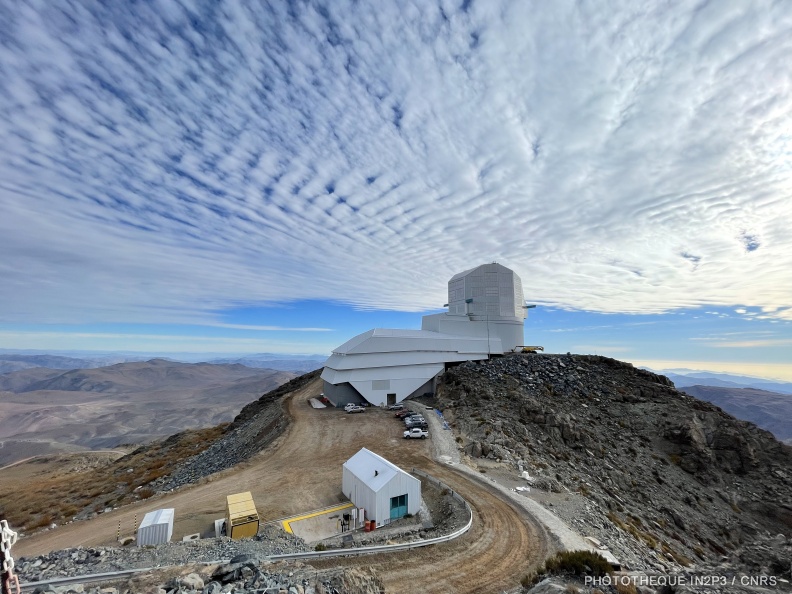
Our team is involved in the construction and scientific preparation of the Rubin Observatory – Legacy Survey of Space and Time (LSST), one of the most ambitious sky surveys ever undertaken.
We study the formation of large-scale structures in the Universe, transient phenomena, and photometric calibration at the sub-percent level.
👩🚀 Who We Are
The IJCLab LSST team has been part of the international DESC – Dark Energy Science Collaboration and the Rubin–LSST Project since their inception.
It brings together researchers, engineers, and young scientists with a shared goal: to prepare the scientific exploitation of 10 years of Rubin-LSST data.
Current composition:
-
2 permanent researchers
-
1 faculty member from Université Paris-Saclay
-
1 emeritus researcher
-
1 postdoctoral fellow
-
1 PhD student
💡 We regularly welcome interns, PhD candidates, and postdoctoral researchers. Feel free to get in touch!
🌌 Research Topics
🌀 Cosmology and Large-Scale Structure
Probing the nature of dark energy through galaxy distribution, morphology analysis, and photometric redshift estimation.
🌈 LSST Photometric Calibration
Measuring and modeling atmospheric transmission (water vapor, aerosols, ozone) using the Rubin Auxiliary Telescope.
🔬 Spectrometry and Optical Instrumentation
Design of a holographic disperser to monitor atmospheric spectral variations via standard stars (CALSPEC, GAIA).
🤖 Artificial Intelligence for Cosmology
Developing machine learning techniques for redshift estimation, rare event detection, and large-scale data analysis.
🛠️ Instrumental Contributions
The IJCLab LSST group has made key contributions to the construction of the Vera C. Rubin Observatory:
-
🔧 Development of low-noise CCD readout electronics
-
💿 Design and implementation of a holographic disperser for spectral calibration
-
🧪 Design and validation of detector test benches
-
🚀 Development of a transportable calibration system for reference telescopes
💻 Data Science and Infrastructure
We are also deeply involved in the development of the FINK broker, a real-time alert processing platform for LSST.
FINK detects, classifies, and redistributes transient events (supernovae, variable AGNs, microlensing events, etc.) to the global scientific community.
⚙️ FINK is a major French contribution to LSST, developed in collaboration with several national laboratories, including IJCLab.
🌟 Other Projects
⭐ StarDice – Aiming for absolute photometric calibration at the sub-percent level, based on laboratory standards traceable to NIST (National Institute of Standards and Technology) references.
🎯 Scientific Goals
-
Investigate variable and transient sources (supernovae, AGNs, kilonovae) as cosmological probes.
-
Achieve ultra-precise photometric calibration, essential for precision cosmology.
-
Train the next generation of scientists at the interface between instrumentation, observation, and data science.
🧭 Are you a student, PhD candidate, or postdoc interested in instrumentation, cosmology, or Rubin-LSST data science?
👉 Join us! Get in touch via the A2C – IJCLab website or through the IJCLab main site.