








Collaboration website with up to date news : https://madmax.mpp.mpg.de/
Last publications :
- MADMAX collaboration, First search for dark photon dark matter with a MADMAX
prototype, Phys. Rev. Lett. 134 (2025) 151004 [2408.02368] - MADMAX collaboration, First search for axion dark matter with a MADMAX prototype, Phys. Rev. Lett. 135 (2025) 041001 [2409.11777]
- Sensitivity of a closed dielectric haloscope to axion dark matter, A. Ivanov et al JCAP 06 (2026) 046 [2603.05006]
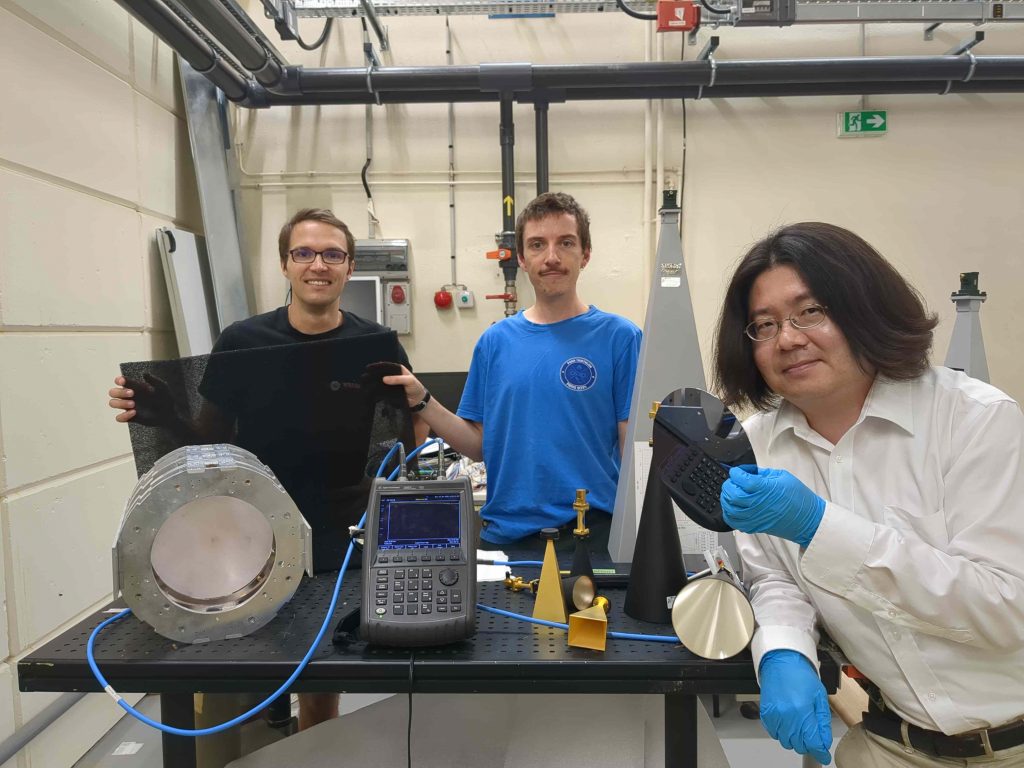
Local team
| Name | Building | Office | Status | |
| Houdy Thibaut | houyd@ijclab.in2p3.fr | 200 | 116a | Prof assist. |
| Kermaïdic Yoann | kermaidic@ijclab.in2p3.fr | 200 | 116a | CNRS staff |
| Miyazaki Akira | miyazaki@ijclab.in2p3.fr | 106 | G122a | Research engineer |
Objectives and research hypothesis
Dark matter (DM) existence is supported by many independent astrophysical and cosmological observations and makes up for 25% of the total energy density of the Universe. If most of the community now support its existence, its nature remains unknown and is one of the most pressing question of particle physics. Due to its long lifetime and interaction with ordinary matter it must though lie outside of the Standard Model of particle physics. Therefore it is the subject of very intense experimental efforts in order to discover properties of such matter.
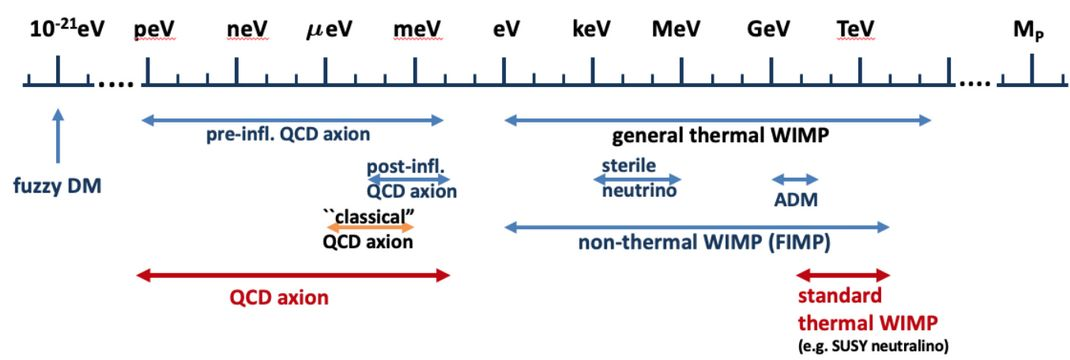
The allowed parameter space of DM mass represented in Figure 1 is extremely wide. Therefore, externally motivated solutions are to be explored first. WIMPs, keV sterile neutrinos and axions are the most popular solutions. WIMP has been the preferred candidate for a long time due to its mass/coupling predictable value (the so called WIMP miracle). However, after long investigations of direct search experiments without discovery, the available phase space is facing the challenge of solar neutrinos coherent scattering, perceived nowadays as a non removable background. Alternatively, the axion, proposed as a long standing solution to bring dynamically θQCD to 0, is also an excellent dark matter candidate. A lot of promising new projects are exploring its existence lately.
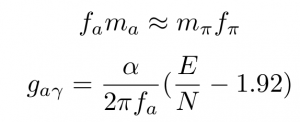
A long standing problem in modern physics is the observed domination of matter over antimatter in the Universe. One of the famous Sakharov’s condition to realise baryogenisis is the violation of the Charge-Parity (CP) symmetry. A CP-violating term exists naturally in the QCD Lagrangian, parametrized by the a priori non zero phase : θQCD. Stringent limit on the existence of a neutron electric dipole moment (nEDM=(0.0±1.1)×10−26 e⋅cm) implies an astonishingly low possible value for a CP-violating term in QCD (θQCD <10-10): this is known as the strong CP problem. The Peccei-Quinn mechanism (PQ) predicted in 1977, generating a U(1)PQ pseudo-boson would naturally explain θQCD equal to 0 while adding a new dynamic field : the axionic field. Simplest QCD-axion models and Cold Dark Matter (CDM) candidate are pointing toward the 1 μeV-1 meV mass range with 15-400 μeV region being well motivated [1] in post-inflation scenario. The main axion parameters to determine are the axion-decay constant (fa), the axion mass (ma) and the gamma coupling parameter (gaγ) related via equations (1), E/N being model dependent (E/N = 8/3 for example in KSVZ) [2].
Three categories of experiments are possible depending on the source of the axions :
- anthropogenic : an intense laser-beam in a static magnetic field produces axions in the so called light shining through wall experiments (ex: ALPS). A wall absorbs the photons, only leaving potential axions crossing the dumper toward the detector.
- haloaxions : axions from galactic halo dark matter interacting with the detector for haloscopes (ADMX, ABRACADABRA, MADMAX, ALPHA)
- solar axions : axions produces within the Sun’s core via Primakoff effect : interaction between the intense solar magnetic field and the black body radiation (x-rays). Experiments targetting these axions are called helioscope (CAST, IAXO).
Most of the axions experiments aim at detecting axions through axion-photon conversion in a very intense magnetic field via the inverse Primakoff effect (a+γ → γ).
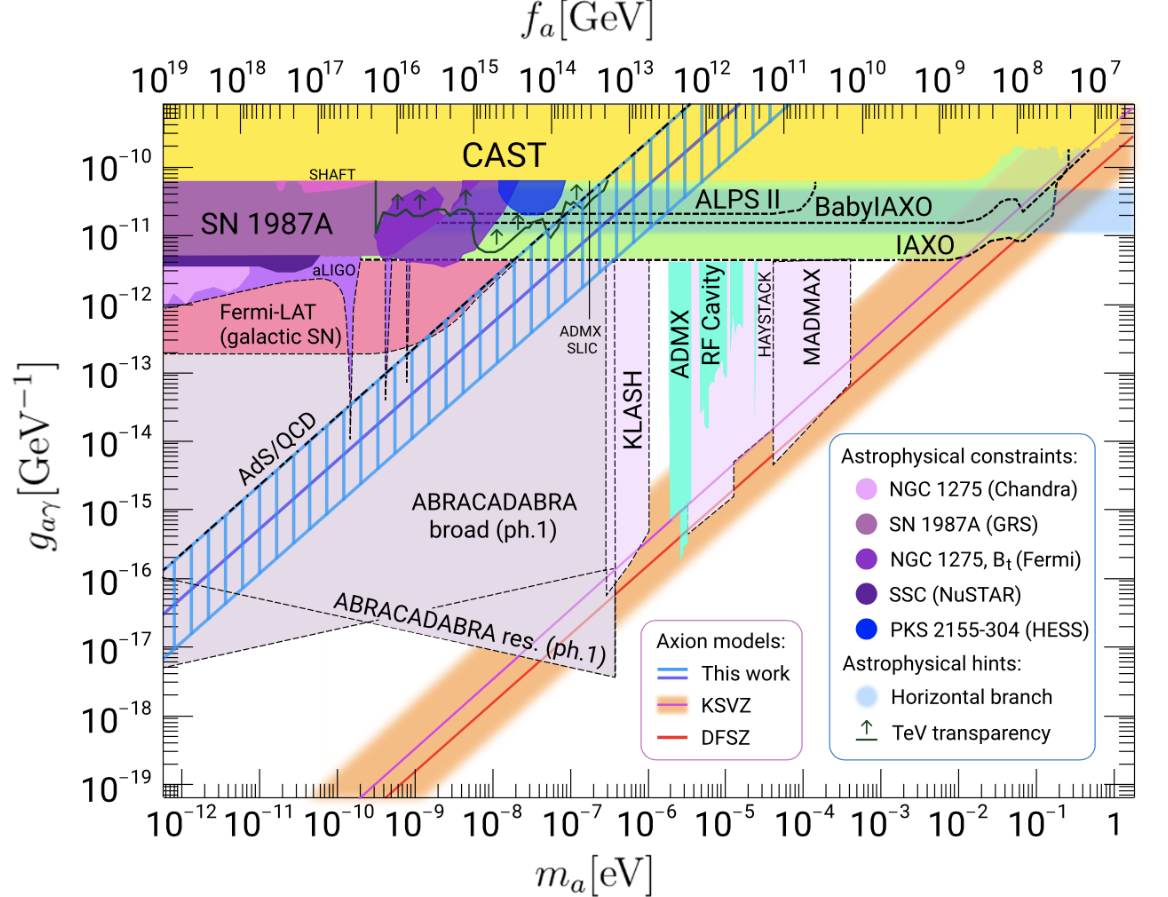
It is worth mentioning that the source production of the axions conditions the result one can extract from the measurement. The helioscope and anthropogenic experiments could observe axions even if they are not dark matter, while haloaxions experiments assume all or most of the dark matter to be axions in order to extract a limit on the gaγ parameter. Anthropogenic experiments are sensitive to gaγ2 (once to produce the axion through Primakoff effect, once to detect it through inverse Primakoff effect). Furthermore, solar axions being produced in the keV range by black body radiation, its detection does not much depend on the axion mass, as illustrated in Figure 2.
Haloscope experiments are the only experiments targeting axion-DM masses and theoretically motivated gaγ values. They rely on converting galactic halo axion into a ~10-22W microwave photon signal. Each haloscope experiment is tuned to be sensitive to a certain frequency (axion-mass) and scans different cavity sizes to explore axion-mass phase space. The main challenge of this latest category of experiment is therefore the amplification chain toward a measurement (resonant cavity, dielectric booster, low noise preamplifier), the scan of different mass ranges and the extremely low level of noise (filters, cryogenics, absorbers). The resonant cavity approach reaches an experimental limit above 10 μeV (f = 2~GHz, ) where the small size of the cavity degrades statistics, amplifying quality factor (skin effect) and signal/noise ratio (quantum noise).
State of the art for axions
The mass range of QCD axions produced by PQ symmetry breaking after inflation is [1 -100]~μeV corresponding to a frequency of [0.2~–~24] GHz. In this area of search the main experiments running as of today, are using a cold resonant cavity standing in a static magnetic field (ADMX, ABRACADABRA, HAYSTAC). They have shown results in a [2.7 – 4.2] μeV, even excluding the DFSZ model for part of this range but are still limited by a very narrow bandwidth which obliged for very careful and tedious scanning to cover the interesting mass range. They are limited by a small bandwidth and the quantum-limited sensitivity. New design to overcome these limitations using oscillating plasma like ALPHA, parabolic reflector in BREAD, exploring the quantum limit of micro cavity like in GraHal or ORGAN exist but are still at the level of feasibility studies. MADMAX is though a unique experiment in term of mass band exploration and a large bandwidth (50 to 200 MHz width) thanks to its unique technology based on a boost factor idea instead of a cavity typical quality (Q) factor.
The dielectric haloscope concept enables to look for axions above 10 μeV. If axion exists, its coupling to the electromagnetism classical law can be described by the so-called axion-Maxwell equations as described in equation (2).

In the presence of a magnetic field B0, the axion field produces a static oscillating electric field Ea with the model dependent parameter Caγ. This would imply a discontinuous Ea at the interface between a dielectric disk of high permittivity (ε>9) and vacuum (ε0). This discontinuity not being allowed, an electromagnetic wave is generated at the interface of two dielectrics (ε1 and ε2) to ensure continuity in the field (Paxion ~10-27W), following equation (3) [3], [4].

This wave is emitted normally to the surface of the disk. Therefore, it can be coherently amplified by accumulating disk at a proper distance. This is the booster effect of MADMAX, illustrated in Figure 2, amplifying the signal by a factor of 50000 (Psignal~10-22W).
MADMAX. The Magnetized Disc and Mirror Axion eXperiment (MADMAX) is a first-generation experiment based on the dielectric haloscope concept using a focusing mirror in one side, 80 LaAlO3 moveable dielectric disks of 1,25 m diameter, a 9 T magnetic field delivered by a superconducting dipole magnet and a low noise amplifier (HEMT) in the other direction, a radio-frequency signal can be extracted in a 4-40~GHz bandwidth. Besides, the full detector must be cooled to cryogenic temperature (4 K) and operated in an intense magnetic field [5].
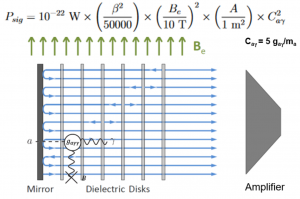
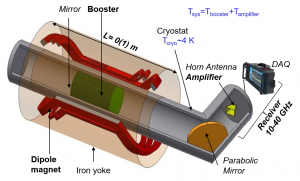
Figure 3: MADMAX physics principle (left) and schematic of the data production and acquisition (right).
The large boosting factor with an enhancement of the signal over 50 to 200 MHz (depending on the disk configurations) enables a quick scan over the 4-40 GHz possible range, unlike narrow peaks in resonant cavities. The collaboration is now under a prototyping phase and feasibility demonstration. The design and construction of a 9 T superconducting magnet with a warm bore diameter of 1.35 m (B2A ~ 100 T2m2) is very challenging. Aside from the magnet, the booster is the main innovation and challenge of the experiment. The experiment must therefore demonstrate the fine planarity and tunability of the disk position (high magnetic field, cryogenic environment, meter-scale objects, 10 μm precision) and precisely determine the boosting factor (RF calibration) [6].
- [1] C.B. Adams et al, White Paper – Axion Dark Matter, Snowmass 2021, arxiv: 2203.14923, (2023)
- [2] P.A. Zyla et al. (Particle Data Group), Review of Particle Physics, Prog. Theor. Exp. Phys. 2020, 083C01 (2020) doi
- [3] The ADMX collaboration, Search for Invisible Axion Dark Matter in the 3.3–4.2 μeV Mass Range, Phys. Rev. Lett. 127, 261803, (2021) doi , arxiv: 2110.06096
- [4] J.L. Ouellet, et al. First Results from ABRACADABRA-10 cm: A Search for Sub-μeV Axion Dark Matter, Phys. Rev. Lett. 122, 121802 (2019), doi, arxiv : 1810.12257v2
- [5] L. Zhong et al., Results from phase 1 of the HAYSTAC microwave cavity axion experiment, Phys. Rev. D 97, 092001 (2018), doi, arxiv: 1803.03690v1
- [6] A. J. Millar et al. (ALPHA collaboration), Searching for dark matter with plasma haloscopes, Phys. Rev. D 107, 055013 (2023), doi, arxiv: 2210.00017